





Former Liverpool boss Jurgen Klopp has admitted that he was ‘stunned’ by Liverpool’s summer spending spree, exactly 10 years on from his arrival at the club, in October 2015.
This heavily contradicted the German’s attitude towards Liverpool’s financial spending habits during his nine-year stint as head coach, a period during which he stated the club “cannot financially compete”, with the likes of Manchester city.
In the summer of 2015, the record for Premier League transfer expenditure was broken for the second consecutive year with clubs spending a combined £870 million.
Manchester City set a record for a single club spending £160 million pounds, with key signings such as Wolfsburg’s Kevin De Bruyne (£54 million), Liverpool’s Raheem Sterling (£49 million) and Valencia’s Nicolas Otamendi (£32 million).
At the time this was a mind-boggling amount of money, with the Premier League dominating the charts and doubling outlay in the second placed league for spending, the Italian Serie A that finished some way behind with a gross spend of £405 million.
In the 2014/15 Premier League season, Liverpool finished sixth place ultimately missing out on Champions League qualification.
With added pressure on Brendan Rogers after the departure of key players such as Luis Suarez, this window provided an opportunity for Liverpool to rebuild on a lacklustre, ageing squad.
Departures such as Raheem Sterling’s £49 million pound move to rivals Manchester City (a Premier League record for an English player at the time), and Steven Gerrard’s retirement move to the MLS significantly decreased the squads ability.
However, the addition of Hoffenheim’s Roberto Firmino (£29 million), proved to be one of Liverpool’s best signings of all time. Going on to stay for eight seasons, ‘Bobby’ Firmino made 362 appearances for The Reds.
He proved to be one of Liverpool’s finest assets during his tenure, contributing with 183 goals and assists.
The signing of Joe Gomez from Charlton (£4.9 million) was the second, and final positive signing during Rogers’ last window as he has provided depth to Liverpool’s defence over the past decade, making 244 club appearances.
After scoring 13 goals in 29 Premier League appearances during the 2014/15 season, Liverpool signed Christian Benteke for £32.5 million from Aston Villa, which was their second most expensive signing at the time.
However, this signing never really came good, as the Belgian would only go on to score 10 times in 42 matches for the club.
Fortunately, Liverpool’s return on investment wasn’t the end of the world, as he left for Crystal Palace in 2016 for £27 million.
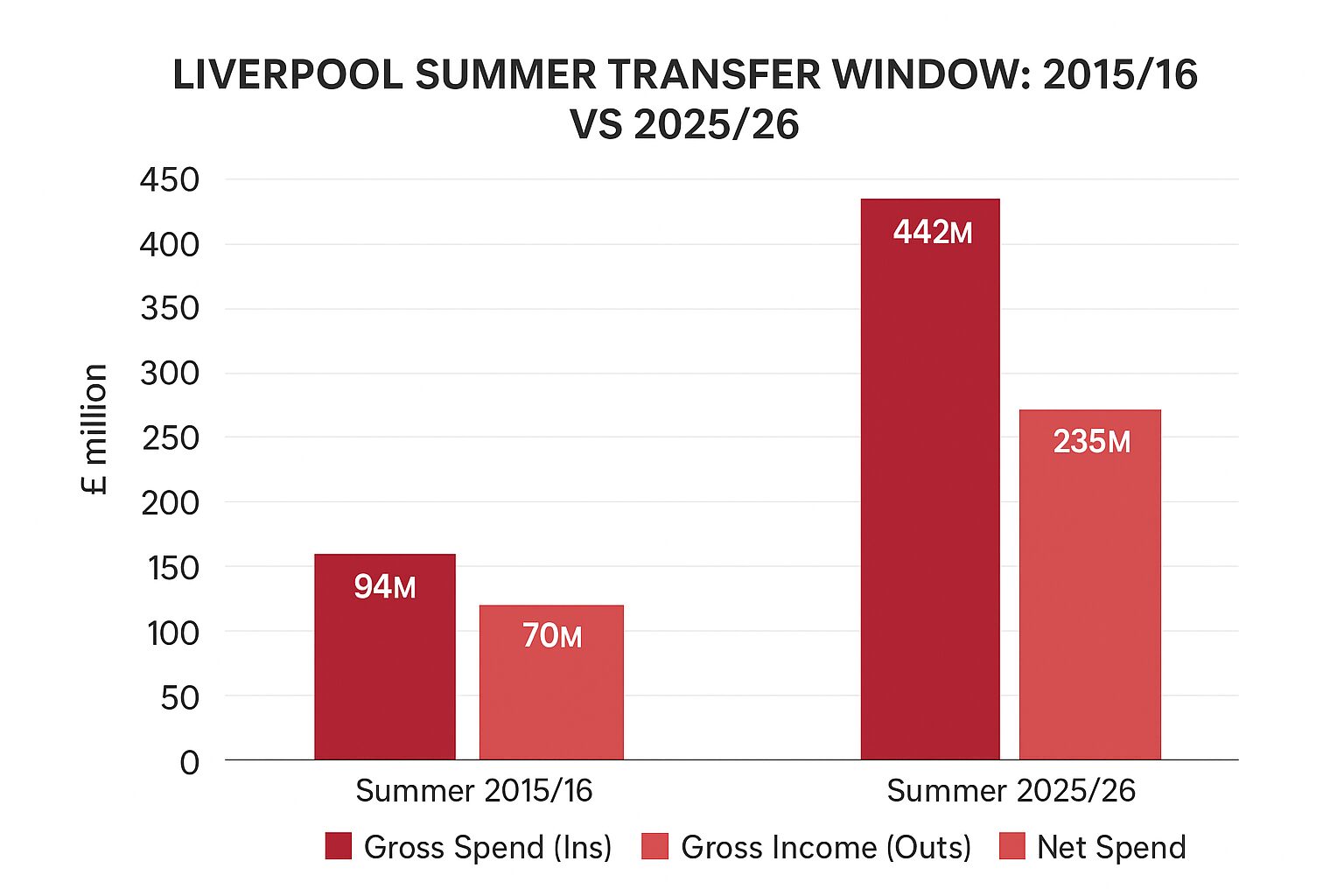
In 2015 Liverpool spent a total of £126 million , with an income of £90 million.

According to the Deloitte Business Group, the summer 2025/26 transfer window saw Premier League clubs spending £3 billion for the first time in history, with Liverpool spending a record of £442.5 million, narrowly surpassing the former record of £434.5 million set by Chelsea in 2023.
The Reds spending was driven by major transfers, such as the acquisition of Newcastle’s Alexander Isak, who joined the reigning champions in September for a British record of £125 million.
Other key transfers, such as the signing of Bayer Leverkusen’s Florian Wirtz (£116 million) and Frankfurt’s Hugo Ekitike (£82 million), saw Liverpool spend £124 million more than the second highest spenders Chelsea.
A decade ago, £400 million was enough expenditure to cover an entire elite football league, but as football and the media grow hand in hand, a system driven by the massive revenue generated from media rights, sponsorships, and ticket sales, that amount is no longer enough for certain individual clubs.