






Making the defence
Liverpool’s defensive performance under Slot had improved significantly through last season, reflecting a more disciplined and structured approach.
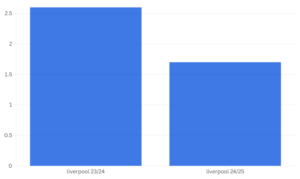
Their expected goals against (xGA) dropped from 1.22 per match in the 2023/24 season to just 0.86 per match in 2024/25, demonstrating a clear reduction in the quality of chances.
Over the course of the season, Liverpool’s total xGA was 28.9, the lowest in the Premier League and considerably lower than any other team except Arsenal.
That is until this season when Liverpool’s defence has been shipping goals for fun. After 11 games in the 2024/25 campaign, the Reds had conceded just six goals. This time out they have leaked 17 goals in the same number of games.

Duels and success
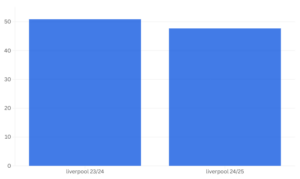
Liverpool’s success rate in duels has become a real sticking point under Slot, and the data backs that up: they started the season winning around 51.2% of their duels, but that figure dropped to about 48.0% later on. This decline isn’t just a quirk it highlights a deeper issue in their physical battles, especially on the ground, which many analysts argue is hurting their capacity for transitions.
Meanwhile, in the air, Liverpool are still imposing. Virgil van Dijk and Ibrahima Konaté remain key to their success, helping the team register one of the highest aerial duel-winning percentages in the league. But despite that aerial strength, the drop in ground duels suggests Liverpool are becoming more vulnerable in the kinds of 50-50s that define control in midfield a worrying trend for Slot.
Efficiency
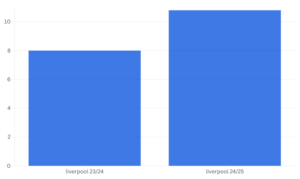
Reduced pressing means fewer aggressive gambles, but the rise in PPDA shows that Liverpool are becoming more selective and deliberate in the way they apply pressure.
Instead of committing to constant, high-energy pressing, Slot’s side focuses on the moments where they can most effectively disrupt opponents. On paper, the defensive improvements from last season suggest this shift can work as Liverpool faced fewer high-quality chances and forced opponents into less threatening shots. But this is where the contrast with the current season becomes unavoidable.
The stability and control that defined Slot’s early defensive structure simply haven’t been replicated this year. While the framework was designed to make Liverpool harder to break down, the team has struggled to maintain the same discipline and intensity, and the reduced pressing has started to look less like a tactical choice and more like an exposed weakness. Opponents are finding it easier to play through Liverpool’s shape, and without the sudden, aggressive triggers that Klopp’s sides were known for, the team often appears passive in phases where they should be assertive.
What was once seen as a sustainable, smarter evolution has contributed to Liverpool being far less effective this season. The selective press is still part of the identity, but without the defensive consistency that supported it last year. Liverpool are conceding more dangerous moments and failing to control games in the way Slot’s system requires.
Instead of representing a refined version of their former “pressing machine,” Liverpool’s current performances highlight how fragile that imbalance can be and why the drop off in structure and timing has played a major role in their struggles this season.