






Mersey Rowing Club is using the power of sport to improve men’s mental wellbeing and challenge rowing’s reputation as a sport for the wealthy.
Based at Liverpool Watersports Centre on Queen’s Dock, the club continues to attract newcomers to the sport through its ‘Learn to Row’ programme.
These are sessions aimed at introducing beginners to the sport as well as building lasting friendships.
Club lead coach Laura Caveney, 32, said: “We’re an open club and Liverpool is a very diverse city in terms of ethnicity, socioeconomic background and religion.
“We offer flexible memberships and open days to make rowing truly accessible to all. We’re also working on plans to bring even more communities together through rowing next year.”
This message of inclusion and mental wellbeing has resonated with its members.
Laura said: “We’ve had lots of positive feedback from the men in our squad, that the club has become a lifeline. A way for them to make new friends, get fit, and get out of the house.”
Male club member Ollie said: “The sense of community at the club has grounded me and restored my sense of purpose and place.
“It’s a welcoming and friendly atmosphere, with an energy very different to other sports clubs I’ve known.
“For the first time since moving to Liverpool I have a desire to stay in the city. To be a part of Mersey, contributing to the club, training with crewmates, and looking forward to every session.
“Since joining, my mental and physical health have both improved. I’ve found a community where I belong.”
The programme lasts six weeks, or two intensive weekends depending on what you book, making it the perfect way to test the waters. Sessions are split between age groups, one for over 18’s and another ‘junior Learn to Row’ programme for under 18’s.
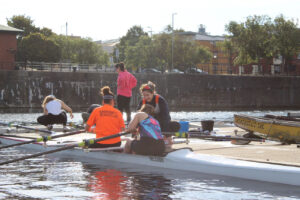
MRC club captain Harriet said: “Participants learn how to effectively train on land using rowing machines to improve their technique, how to row on water such as skulling technique, in a coxed four-person boat.
“We also provide an induction pack which helps them to understand how Mersey Rowing Club functions as well as crucial terminology and systems.”
Despite being one of Britain’s oldest sports, rowing has at times struggled for popularity. The sport has long carried the reputation of being ‘elitist’ and for the affluent.
This isn’t a recent issue; it’s deep rooted in the history of the sport. This can be traced all the way back to 1879 when the Henley Royal Regatta, Britain’s biggest rowing competition, introduced the ‘manual labour bar’.

This stopped any manual workers from taking part in the event, although this rule was revoked in 1938, it left a stain on the sport.
The sport is still heavily associated with Oxbridge, an institution that was traditionally for the rich. This is due to the annual set of rowing races between Oxford and Cambridge in ‘The Boat Race’ event, this has taken place since 1829.
Harriet said: “As a club based in a metropolitan city with areas of deprivation, we are particularly focused on giving children that would previously not have had the chance to row, every opportunity at Mersey.”
Rowing is one of Team GB’s most successful sports at the Olympics. It was the only sport in which Britain won at least one gold medal at every games between 1984 to 2016.
The success of the team helps boost interest in rowing after each Olympic Games. This was no different at Paris 2024 when the teams eight medal tally (3 gold, 2 silver, and 3 bronze) was bettered by no other nation.
Even with the clubs success, they still feel change needs to be made to bring more male participants into the club.
Laura said: “Learn to Row is usually more women than men taking it up.
“I think women are generally braver when it comes to trying to start a new social circle. It’s something I want to balance the odds on.”
The club regularly competes in national and regional events.
Laura said: “We’re building crews up to men’s and women’s head of the river which is a 6+k race on the Thames. It’s the pinnacle of winter racing for the club.
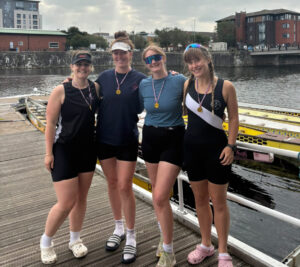
“If anyone is interested in coming down to meet the squad, we regularly host MerseyGatta events where the squad races amongst themselves.”
For any further information on the club, you can visit www.merseyrc.com.